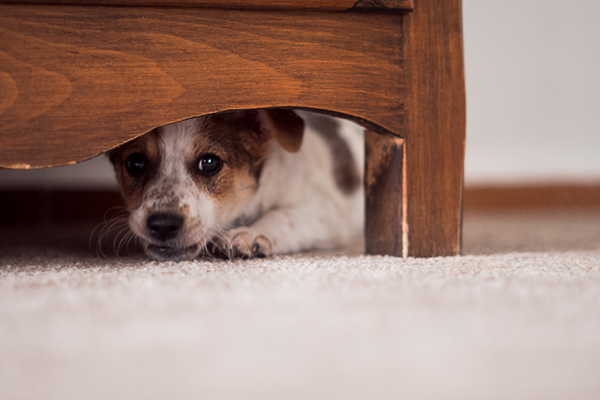
Does your dog get scared by loud noises like firecrackers and thunder? Is it to the point of being called a noise phobia? How can we differentiate between just discomfort and a phobia? Well, dogs with noise phobia show very intense symptoms like, panting, pacing, whining, chewing, and destroying things around the house, drooling, hiding, and even escaping by chewing through doors and windows.

I had a bull terrier female and she was immensely scared of loud noises. It started with firecrackers and then proceeded on to thunderstorms. It got so worse that at one point in time she was afraid just of rain and any vehicle making loud noises as well.
Her reactions were so hysterical that she would pant and drool excessively for hours on end and would become a danger to the house and herself while trying to escape her crate by chewing through it and in the process sustaining so many injuries to her mouth and teeth if she was left alone even for a moment. She clearly showed signs of generalizing her fears. She clearly had noise phobia with an anxiety disorder as well.
It was obviously getting dangerous and she couldn’t be left alone during the storms at all so we sought veterinary help. As Vets say that in such severe cases, Medication can reduce the level of fear and anxiety for other storm or noise phobia treatment methods to work, such as the use of thunder shirts or safe zones.
Using pressure to relieve anxiety is a common practice and a thunder shirt applies gentle and constant pressure on the pet’s torso. The pressure works similar to swaddling an infant.
A safe zone is a sound proof area which is easily accessible to the pet during storms or anxiety. This safe zone can be made comfortable for them by adding a comfy bed, there essential things like blankets and water around and always making sure they can access this place when they are alone at home.
The dog will often choose their own safe zone but it might be:
- a bathroom
- interior closets
- under or behind furniture
The message that needs to be put out there is that medication can help with worse cases where o dog becomes a danger to its own life, as no one wants their pet to get lost or injured because they were not able to manage their pet’s anxiety.

 Loud Thoughts
Thank you for this, now I know how to proceed if my future dog is showing those signs. How did you give her the medication? Did you put it in the food? Because as far as I know is not easy to medicate a dog, especially if you try to give it a pill.
LikeLike
Hi there! Thanks a lot for liking this article.
I have raised many dogs up until now and thankfully have never faced any serious issue with pills as medication, in fact, it’s the liquid medication that I find challenging to administer.
However, the method I use is, before giving the actual pill, I play a little catch game with my pet using the small swallowable treats. 3-4 times of tasty catch and then it’s the pill and if the pill is big and clearly pungent, then I hide the pill inside a small bite of banana and voila! pill swallowed.
An easier way to do just that is to keep the pill on the very top of the dog food/kibble when you are feeding so that the first thing dog eats is the pill. This method works almost always.
I hope this will help you in the future.
LikeLiked by 1 person
Thank you so much for this information. I will have a dog in the future and wanted to know “the method”. Playing a game is always fun! 🐶🦴
LikeLike
You’re right, playing a game is always fun and Thank you for asking the question. It’s always a pleasure to be able to help fellow animal lovers with different tasks. I really hope you welcome a pet into your life soon and that the experience will be worth it. And soon we will share more knowledge of pets over here. Always welcome!
LikeLike
Called by to thank you for your recent decision to follow Learning from Dogs. Thank you!
LikeLike
Hi Paul, Thank you for creating such a beautiful space. I really enjoyed reading your articles and would surely check out more of them. I appreciate what you and your content stand for.
LikeLike